Teachers often recommend practicing with AP 10th Class Biology Model Papers Set 7 to enhance exam readiness.
AP SSC Biology Model Paper Set 7 with Solutions
Time : 2 hours
Max. Marks : 50
Instructions :
- Question paper consists of 4 sections and 17 questions.
- Internal choice is available only for Q.no. 12 in section III and for all the questions in section IV.
- In the duration of 2 hours, 15 minutes of time is allotted to read the question paper.
- All answers shall be written in the answer booklet only.
- Answers shall be written neatly and legibly.
Section – I (6 × 1 = 6 M)
Note :
1 Answer all the questions.
2. Each question carries 1 mark.
Question 1.
How are the aveoli designed to maximise the exchange of gases?
Answer:
The alveoli provide a surface where the exchange of gases can take place. The walls of the alveoli contain an extensive network of blood vessels.

Question 2.
In a food chain of frog, grass, insect and snake assign trophic level to frog.
Answer:
Grass → Insect → Frog → Snake Frog comes at the 3rd trophic level.
Question 3.
A man with blood group ‘A’ marries a woman with Blood group ‘O’ and their daughter has blood group ‘O’. Is this information enough to tell you which of the traits-blood group A or O is dominant? Why or why not ?
Answer:
Blood group ‘O’ is dominant because in F1 generation only dominant traits appear.
Question 4.
Use of paper is more environmentally friendly than the use of polythene for packaging. Jus-tify.
Answer:
Paper bags are more environmentally friendly because they are biodegradable, meaning they can break down naturally, while polythene (plastic) is non-biodegradable and can cause pollution.
![]()
Question 5.
Define heredity.
Answer:
Heredity refers to the passing on of genetic traits and characteristics from parents to their off¬spring through the transmission of genes.
Question 6.
What criteria do we use to decide whether something is alive?
Answer:
Respiration, digestion, excretion, movement, reproduction etc., are the criteria to decide whether something is alive.
Section – II (4 × 2 = 8)
Note:
1) Answer all the Questions.
2) Each question carries 4 marks.
Question 7.
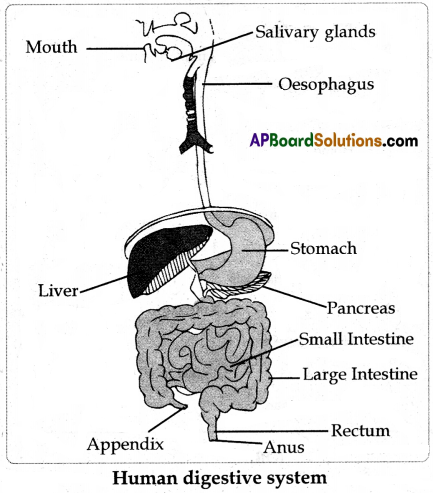
What is the role of saliva in the digestion of food?
Answer:
Saliva performs the following functions in the digestion of food. It moistens and lubricates, food and helps in swallowing. It contains an enzyme, salivary amylase, which carries out partial digestion of starch into maltose.
Question 8.
What is need for a system of control and co-ordination in an organism?
Answer:
- The integration of nervous system and hormonal system is brought about by neuro hormones which regulates the secretion of pituitary hormones.
- The pituitary hormones in turn, regulate growth and secretions of other endocrine glands.
- In this way both the systems control and co-ordination various activities of body.
Question 9.
Give any two ways in which biodegradable substances would affect the environment.
Answer:
- Stink : Within a day or so waste biodegradable substances begin to stink and produce foul IV gases.
- Pests and Pathogens : The decaying biodegradable substances become breeding places of flies and many other pests. They also contain a number of pathogens. Flies and other pests carry the germs to all the places visited by them resulting in spread of diseases.
Question 10.
Observe the food chain :
Plant (1000 kJ) Goat Lion
(a) If autotrophs occupying the first trophic level are called producers, what are herbivores called?
(b) How much energy does the lion get in the above food chain?
Answer:
(a) Herbivores are called primary consumers.
(b) The lion gets 10 kJ of energy in the above food chain, as per the 10% law (10% of energy transfer from one trophic level to the next).
Section – III (5 × 4 = 20 M)
Note:
1) Answer all the questions.
2) Each question carries 8 marks.
3) Each question has internal choice.
Question 11.
What are the differences between autotrophic nutrition and heterotrophic nutrition?
Answer:
| Autotrophic Nutrition | Heterotrophic Nutrition | |
| Definition | The ability to synthesize organic compounds | Obtaining organic compounds from external sources |
| Energy Source | Light (photosynthesis) or inorganic chemicals | Organic compounds or other organ¬isms |
| Examples | Plants, algae, some bacteria | Animals, fungi, most bacteria |
| Carbon Source | Inorganic carbon dioxide (CO2) | Organic compounds (carbohydrates, proteins, etc.) |
| Nutrient Requirements | Inorganic nutrients and water | Organic nutrients (proteins, carbohydrates, etc.) |
| Mode of Nutrition | Self-sufficient, can produce own food | Depend on other organisms for food |
Question 12.
A) Look at the given figure and identify the parts of neuron on the basis of given description:
i) The part where information is acquired.
ii) The part through which information travels as an electrical impulse.
iii) The part where the impulse must be converted into a chemical signal for onward transmission.
Answer:
i) Ends of dendrites acquire information.
ii) Through cell body (cyton) to axon and along axon to axon’s end information travels in the form of electric impulse.
iii) The electrical impulse sets off release of some chemicals (neurotransmitters) at the ends of axon which is necessary to cross the gap (synapse) to reach dendrites of hext neuron to start similar

(OR)
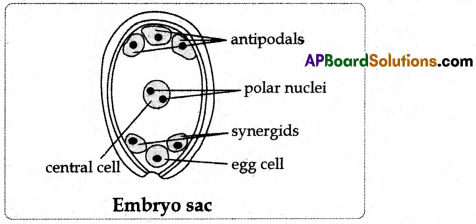
B) Draw a labelled diagram of the longitudinal section on a flower.

Question 13.
Why is damage to the ozone layer a cause for concern? What steps are being taken to limit this damage?
Answer:
- The most important gas present in the stratosphere is ozone. At an altitude of about 23 km,
its concentration is about 10 ppm. - Ozone absorbs ultraviolet radiation coming from the sun and thus protect us from the harmful
effects of the ultraviolet radiation. - Ultraviolet rays are known to cause skin cancer, eye damage and damage to the immune system.
- It also kills the minute aquatic plant life, the phytoplanton. But the amount of ozone in the atmosphere began to drop sharply in 1980s.
- This decrease has been linked to synthetic chemicals like CFCs which are used as refriger ants and is fire extinguishers.
- Ozone is a very reactive compelemt and it oxidise CFCs. In doing so, ozone is converted into gain oxygen.
Ozone + CFC → Oxygen + Oxidation
Thus ozone layer is depleted and it allows the harmful radiations i.e., W radiations on earth which cause so many negative effect on human beings, which are already discussed. So depletion of ozone layer is harmful for living things on earth.
Control Measures:
1. By reducing the use of CFOCs, many countries have already banned the use of CFCs.
2. By developing substitutes to replace CFCs. These include the compounds called Hydro Fluoro-Carbons (HFC-134), Hydro-ChloroFluro-Carbons (HCFCs) and Methyl CycloHexane (MCH)
![]()
Question 14.
Why does menstruation occur?
Answer:
- Menstruation occurs as part of the menstrual cycle, which encompasses events in the genital tract, ovaries, and uterus.
- It is marked by the flow of menstrual blood approximately every 28 days.
- The cycle starts from the first day of blood flow during the menstrual period.
- The first 14 days, known as the proliferative phase, involve the growth of ovarian follicles into mature follicles.
- Ovulation occurs on the 14th day when a mature ovum is released from the ovary.
- During the subsequent secretory phase, the inner wall of the uterus thickens, and the ovum moves into the fallopian tube.
- If fertilization does not occur, the unfertilized oocyte undergoes autolysis, leading to the nip ture of blood vessels and subsequent bleeding.
- This process is known as menstruation or menstrual flow and typically lasts for about four days.
Question 15.
(a) Why s nutrition necessary for the human body’ .
(b) What causes movement of food Inside the alimentary canal?
(C) Why Is small Intestine ¡n herbivores lonqer than in carnivores?
(d) What will happen If mucus is not secreted by the gastric glands?
Answer:
(a) For performing any activity like walking, cycling, etc., human beings use energy. Even when
Section – IV (2 × 8 = 16 M)
Note:
1) Answer all the questions.
2) Each question carries 8 marks.
3) Each question has internal choice.
Question 16.
A) Describe an activity to show that chlorophyll is essential for photosynthesis.
Answer:
Aim: To prove that chloroplasts are necessary for photosynthesis.
Apparatus : Potted plant with variegated leaves (croton plant), alcohol, water-bath, iodine, bun¬sen burner.
Procedure :
- A potted plant is taken and it is kept in dark for three days to make the leaves destarch.
- Then the plant is placed in sunlight for six hours for the purpose of photosynthesis.
- In the evening, the plant is taken in, one of the leaves is plucked out and its outline is drawn on paper with marking the green areas of the leaf.
- The leaf is placed in boiling water for a few minutes.
- Then, it is immersed in a beaker of alcohol and heated on water bath. The leaf became pale in colour because of the removal of chlorophyll.
- Then, the leaf is dipped in diliodine solution.
Observation: Some parts of the leaf turned into the black colour.
Inference:
- On comparing with the paper sheet drawing
- it is observed that the leaf parts which were green in colour turned to black
- as starch is formed in that due to photosynthesis.
- The other parts of leaf remained pale only, as there was no starch formation.
Conclusion: So, it is proved that starch is formed in the areas of leaf which contain chloroplasts. Hence concluded that chloroplasts of leaves are necessary for photosynthesis.

(OR)
B)
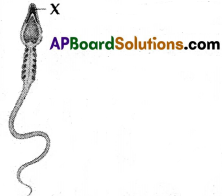
a) Draw labelled diagram of human male reproductive system.
b) State the reason why testes are located outside abdominal cavity.
c) Name the hormone secreted by testes.
d) Write two glands found in male reproductive pathway and specify their roles
Answer:
a) 
b) The scrotum serves a dual purpose by protecting the testes and acting as a thermo regulator. It does so by changing the position of the testes. It helps maintain a lower temperature for the testes, typically 1-3° C below the body tempera-ture. This lower temperature is crucial for the development of sperms.
c) Testosterone : Testosterone plays a vital role in regulating the formation of sperm cells in the testes. It is responsible for the onset of puberty changes in males, including the development of secondary sexual characteristics. Testosterone also helps in the maintenance of male secondary reproductive organs and traits.
d) Two Glands : Seminal Vesicles and Prostate Gland.
Seminal Vesicles : These glands secrete approximately 60-70% of the seminal fluid. The fluid is alkaline and viscous, containing fructose (providing nourishment to the sperms), fibrinogen, proteins, and prostaglandins. Prostaglandins, cause movements in the female genital tract, aiding in the movement of sperms. The secretions from seminal vesicles also activate the sperms.
Prostate Gland : The prostate gland produces around 20-30% of the seminal fluid. The secretion is alkaline and viscous. It contains a clotting enzyme and chemicals essential for sperm activity.
![]()
Question 17.
A) How does phototropism occur In plants?
Answer:
Plants are autotrophs i.e., they manufacture their own food in the presence of sunlight. Therefore, they respond to light by growing towards it. Plants also turn their leaves towards the sun to ensure that the latter get maximum sunlight.
Requirement: Two potted plants.
Method : Take two potted plants. Keep one plant in the open so that it receives the sunlight com¬ing from above: place the other plant in a room near the window in such a way that it receives sunlight from one side only i.e., through window.
After some days observe both the plants.
Observation : The first plant (which was kept in the open) has grown up straight towards light. The second plant which was kept in the room and receiving light from one side has grown by bending towards the light.
Explanation and conclusion : This movement of the plant part stem is caused by the action of auxin hormone. The auxin hormone is formed by the meristematic tissue at the tip of stem.
i) Auxin spreads uniformly Down the stem in plant kept in the open arid receiving sunlight from above. Due to presence of auxin equally on the both sides the stem grows up straight because both the sides of the stem show growth at the same space.
ii) The second plant is receiving light only from one side through the window. In this case the auxin hormone moves from tip of stem to be concentrated more on the side not receiving light. Due to presence of more auxin hormone the shady side of stem grows faster than the side of stem receiving light. As a result, the stem bends towards the direction of light. This experiment
shows that the stem of the plant responds to light by showing growth movement towards light (positive phototropism).
(OR)
B) a) What are chromosomes? Where are they seated?
b) What is a Sex chromosome?
c) Explain the mechanism of sex determination in human beings.
Answer:
a) In case of asexually reproducing organisms, there is no gametogenesis and fertilization. Chance separation and chance pairing of genes and their chromosomes are absent. Therefore, asexually developed individual carries the same genes and their chromosomes as are present in its parent.
b) Allosomes (Gk. alio – other, soma – body) or sex chromosomes are those chromosomes which determine the sex of the individual in unisexual organisms. Human beings have 23 pairs of chromosomes.
c) Establishment of male and female individuals through differential development of their sex organs is called sex determination. In some organisms sex is determined by environmental conditions. In others including human beings, it is determined genetically.
Environmental Determination of Sex :
- Crepidula (marine mollusc) and Bonellia (marine worm) develop into females if growing alone. In the company of a female, they develop into males.
- In turtle, Chrysema picta an incubation temperature above 33°C produces females while a temperature below 28°C produces only males.
- In lizard, Agama agama, high incubation temperature produces male offspring.
- Annelid Ophryotrocha is male in young state and female later on. Snails are also known to change sex.