
Note Making Inter 2nd Year English Grammar

Students prefer AP Inter 2nd Year English Grammar Pdf and Note Making in English Inter 2nd Year for mastering language skills.

Inter 2nd Year English Note Making with Answers

Note Making in English Inter 2nd Year

→ Note making is a very important and useful skill.

→ Note making is identifying the main points in a given text and presenting them is a systematic way.

→ You are all familiar with this skill. Suprised ? Yes, you watch a movie and relate to your friends the story of that film. That is note making!

→ Note making involves first

  1. understanding the text,
  2. then identifying the main points, (editing) and
  3. finally presenting those points neatly.

→ Because of the multiple advantages note making presents to you, practise it, revise your notes and refine them.

Now begin with observing the following model.

Sample Note Making:

Sonnet: A lyric poem consisting of a single stanza of fourteen iambic pentameter lines linked by an intricate rhyme scheme (Refer to meter and rhyme.) There are two major patterns of rhyme in sonnets written in the English language.

The Italian or Petrarchan sonnet (named after the fourteenth-century Italian poet Petrarch) falls into two main parts; an octave (eight lines) rhyming abbaabba followed by a sestet (six lines) rhyming cdecde or some variant, such as cdccdc. Petrarch’s sonnets were first imitated in Englad, in both their stanza form and their standard subject by Sir Thomas Wyatt in the early sixteenth century. The Petrarchan form was later used, for a great variety of subjects, by Milton, Wordsworth, Christina Rossetti, D.G. Rossetti, and other sonneteers, who sometimes made it technically easier in English (which does not have as many rhyming possibilities as in Italian) by introducing a new pair of rhymes in the second four lines of the octave.

The Earl of Surrey and other English experimenters in the, sixteenth century also developed a stanza form called the English sonnet, or else the Shakespearean sonnet, after its greatest practitioner. This sonnet falls into three quatrains and a concluding couplet, abab cdcd efef, gg. There was a notable variant, the Spenserian sonnet, in which Spenser linked each quatrain to the next by a continuing rhyme: abab bcbc cdcd ee.

The important points of the above passage can be presented as a tree diagram.

Note Making Inter 2nd Year English Grammar 1

Note Making Inter 2nd Year English Grammar

Now examine another model.

Holidays give students rare, unhurried time. Reading during this break strengthens attention, expands vocabulary, and offers calm, screen-free relaxation. Yet many children drift away from books because of powerful distractions – mobile games, streaming shows, or constant notifications. Access can be another barrier: library fees, the cost of new books, or uncertainty about which titles are age appropriate. A simple plan overcomes most hurdles. Fix a short daily reading slot of 20-30 minutes, preferably at the same hour. Use the ‘five finger rule’ to choose the right level-if five words on a page are too hard, try another book. Mix genres so reading stays fresh : stories, biographies, science comics, travel writing, even magazines. Create social nudges-reading buddies, family read-alouds, or a weekly book-share. Schools can support with classroom libraries, book talks, and reading journals; parents help most by modelling the habit themselves, limiting screen time, and letting children choose. With steady practice, holidays turn into a launchpad for deeper comprehension, creativity, and confidence that lasts through the year.

Now observe the following notes.

Reading Habit

1. Reading
a) increases focus
b) builds vocabulary
c) offers relaxation
d) serves as a launchpad for year-long learning

2. Distractions
a) phones
b) lack of libraries in reach
c) poverty to buy books
d) inability to select suitable books

3. Easy plan
a) 20-30 minutes per day for reading
b) five new words on a page – difficult
c) go for variety
d) ignore comments
e) family read-aloud; practice weekly book-share

4. Support
a) from school-library-book talks
b) from family-model reading; limit screens

5. Result
a) enhances comprehension, creativity, confidence
b) reading continues for longer periods.

→ Mind Mapping is another way of Note Making.

Observe the example carefully.

Rabindranath Tagore (1861-1941), most eminent modern Bengali poet was alsoa critic, essayist, composer and author of short fiction and innovative in Bengali literature. He is known outside India principally in English translation. Gitanjali, a song offering (1912), his free verse recreations of his Bengali poems modelled on medieval Indian devotional lyrics, won the Nobel Prize for Literature in 1913, its first award to an Asian. Representative translations followed, of philosophical plays such as Chitra (1913) and The King of the Dark Chambers (1914) and his novels The Home and the World (1919) and Gora (1924). His short fiction often comments powerfully and courageously on Indian and social concerns, in the collections Hungry Stones (1916) Broken Ties (1925) and The House Warming (1965) and in the novella The Broken Nest brought out his powerful depiction of social issues. Tagore had an excellent command of English, but he wrote primarily in Bengali and tirelessly encouraged other writers of the Indian vernaculars.

Note Making Inter 2nd Year English Grammar 2

Now watch carefully the notes of another passage.

The word ‘Literature’ is really hard to define. Many interpretations are made about the word. But all are incomplete. Some opine that literature is the mirror of life, some others say that it is the criticism of life. Whatever may be the controversy about the word, we may say that literature is that which reflects life. The branches of literature are poetry, drama, novel and short stories. Poetry is of two kinds, imaginative and realistic. Drama is either a comedy or a tragedy. Novels are also of many kinds historical, psychological, realistic, scientific and regional. Short story is one which stands very close to life despite a little scope.

Note Making Inter 2nd Year English Grammar 3

Note Making Inter 2nd Year English Grammar

Exercises

1. Photosynthesis is the process by which chlorophyll-containing organisms-green plants and algae-capture energy in the form of light and convert it to chemical energy. Almost all the energy available for life in the earth’s biosphere-the zone in which life can exist-is made available through photosynthesis.

In the first stage of photosynthesis, chlorophyll absorbs sunlight. Chlorophyll is the green substance in leaves, which is able to trap the energy of sunlight and use it in the process of making carbohydrates.

Within the leaf, there is a small amount of water. The energy, which the chlorophyll has trapped of the sun, is used to split the water in the leaf into hydrogen and oxygen. Most of the oxygen is released into the air. In the second stage, the chlorophyll uses the energy absorbed from sunlight to combine the hydrogen (which is obtained by splitting the water) with carbon dioxide (which the leaf obtained from the air). Then, after several complicated changes, the hydrogen and the carbon dioxide are combined in such a way that a carbohydrate is produced. This carbohydrate is called glucose. Later, using glucose as its most important building material, the plant can make substances called amino acids and proteins. These chemicals are needed for the growth of both plants and animals.

Something else happens during photosynthesis that is of the greatest importance to us. A constant Supply of oxygen is released into the air by plants. At the same time, carbon dioxide, which would poison us if we breathed too much of it, is nearly all used up.

Photosynthesis is one of the most important chemical pro¬cesses in the world. This is because it is the primary method of food manufacture, and the primary method of oxygen manufacture.

A.

Note Making Inter 2nd Year English Grammar 4

2. Intensive reading is aimed at mastering the structures and vocabulary apart from reading for comprehension. The pupils have more opportunities to learn the aspects of the language through intensive reading. If properly carried out, even non-native speakers of English may develop themselves into better users of English than the native speakers of English in writing. Intensive reading can also be done in the absence of the teachers. So, by spending more time on intensive reading, one may get language skills in English. And the only practicable means of learning a foreign language as a second language is through intensive reading. The intensive reading has some prerequisites like; the readers should be able to identify the words and sentences spoken orally and acquire sufficient speed in reading.

In intensive reading, the pupils pay attention to almost all aspects of language. And further the effort of learning the language is supplemented by extensive reading. Extensive readers should read interesting stories. Magazines, newspapers and variety of story books will form the material for extensive reader. The two main themes of extensive reading are reading for pleasure and reading for information. Extensive readers facilitate passive vocabulary in the learners. And it also consolidates active vocabulary. So, the teachers should regularly give some assignment and thus force the students to library. Sending the students to library can be done as a means of assertive punishment also. As the students read more and more books, their power of phonic analysis im¬proves and makes the learner to pronounce any word that he sees for the first time. Group discussion also can be done on extensive reading.

A. Intensive and Extensive Reading

1. Intensive Reading helps one
a) master vocabulary and structures.
b) become better English writers.

2. Teacher not necessary
a) self-learning- more effective
b) requires some knowledge of words, structures

3. All aspects of language are observed.

4. Extensive Reading
a) supplement intensive reading
b) provides pleasure; information
c) builds passive vocabulary
d) consolidates active vocabulary

5. Extensive reading
a) may be encouraged
b) may be given as assignments
c) may even be given as punishments
d) may be treated as topic for group discussion

Note Making Inter 2nd Year English Grammar

3. Language that we use keeps the human being in an exalted position when compared to other living things. Language is needed for all the people irrespective of their status. And, it is used from our birth till death. Language is a means of com¬munication. We use the language as a medium through which thoughts are conveyed from person to person. It is considered a means of social control. No society can function with¬out language. Language is part and parcel of our life. We cannot imagine a society without language. If no language, then the progress of mankind will be blocked. We will be deprived of all the niceties of life that we enjoy now. Habit formation is necessary for language learning and using. Learning a language involves establishing the links between the language forms and their meanings.

The process of establishing the link between the forms and meanings are three, namely, (i) the form, (ii) the meaning and (iii) their association. In speaking, the speaker associates the exact form with the meaning that he knows, and in understanding he associates the meaning with the form he learned from others. The speaker of the language is Conscious of the words he uses and forms meaningful sentences that can make the listener understand. At the time, the speaker adjusts the sounds to meaningful words and words to meaningful sentences. Language has three functions. The first one is the informative function, where information is communicated. The second function of the language is expressive, where we express our feelings, emotions and our opinions. The third function of the language is directive, where we teach others, give advice etc. So, for meaningful life we require language.

A. Language – Importance – Learning

1. Language helps man
a) keep himself above animals
b) communicate
c) maintain social relations
d) pursue education, employment etc
e) enjoy niceties of life

2. Language is essential
a) for everyone
b) all through one’s life

3. Learning language includes establishing links between forms and their meanings.

4. Languages
a) inform
b) express and
c) direct (instruct)

4. Body shaming is a harmful behaviour where people criticize others based on their physical appearance. This includes making negative comments about someone’s weight, height, skin colour, or other physical traits.

Body shaming can take many forms such as : weight-based shaming: This is one of the most common forms, where people are criticized for being ‘too fat’ or ‘too thin’. People often comment on someone’s weight without realizing how hurtful it can be. Comments like “Why are you so fat?” or “You look like a stick” are examples of weight-based shaming. Skin Colour Shaming: India has a deep-rooted issue with colourism, where people are judged for having darker skin tones, with people often making comments like “You’ll look better if you lighten your skin.” This type of shaming is not only hurtful but also promotes a harmful preference for fair skin over darker skin. Height Shaming: Tall or short, people can face body shaming based on their height. Comments like “Why are you so short?” or “Do you play basketball because you’re tall?” may seem innocent but can make teenagers feel out of place or self-conscious about their height. Face and Features Shaming: Teenagers often face comments about their facial features, such as nose shape, jawline, or even acne. Remarks like “Your nose is too big” or “Why do you have so many pimples?”‘ can deeply affect a teenager’s self-confidence.

Social media often promotes unrealistic beauty standards, making young people feel that they must look a certain way to be accepted. Influencers and celebrities post edited pictures that show only their ‘perfect’ sides, leading teenagers to feel pressured to look the same. Unfortunately, this creates a cycle where teenagers compare themselves to these impossible standards and feel inferior when they cannot match them. Moreover, trolls and cyberbullies on social media leave hurtful comments on people’s pictures, furthering body shaming.

Movies often show heroes and heroines with fair skin, slim bodies, and certain ‘ideal’ features. Characters who don’t fit these standards are often cast as sidekicks, comedians, or villains, indirectly telling the audience that only certain looks are acceptable for ‘good’ or ‘successful’ people. This sets a high and unrealistic standard for teenagers, who may feel pressured to look like these stars. Some might even resort to extreme diets, over-exercising, or skin-lightening treatments to match these unrealistic standards.

A. Body Shaming

1. Body shaming is
a) harmful
b) based on

  • weight
  • height
  • skin colour
  • facial features

2. Body shaming comments include
a) too fat
b) like a stick
c) very short
d) too dark
e) big nose
f) lots of pimples

3. Social media and cinema
a) set unrealistic standards

b) force innocent teenagers to
i) lose their confidence
ii) resort to
A – extreme-diets
B – over-exercising
C – skin-lightening treatments all harmful.

Note Making Inter 2nd Year English Grammar

5. The healthy eating plate is a guide to eating balanced meals, especially for individuals with diabetes. It emphasizes por¬tion control across three main food groups and advises limiting food intake if overweight. To create a healthy plate, start with a small plate or bowl about the size of your outstretched hand : Vegetables: Fill half your plate with a variety of vegetables, either cooked or raw. Include vegetables of different colours to ensure a range of nutrients. Avoid counting tubers like potatoes as vegetables, as they are starches that can raise blood sugar levels significantly. Starches: Reserve one-quarter of your plate for whole grains and healthy starches, which contain fiber and have a milder effect on blood sugar than refined starches like white rice, bread, or pasta. If refined starches are preferred, consume them in smaller portions. Protein: Use the remaining quarter for lean protein sources such as beans, nuts, yogurt, fish, eggs, and poultry. These can be eaten alone or incorporated into dishes like soups, salads, and stews. Red meat should be eaten rarely, if at all.

Additionally: Use healthy oils, such as sunflower or safflower oil, while avoiding processed oils like margarine or vegetable shortening. For beverages, plain water is best. Coffee or tea without sugar is acceptable. Avoid sugary drinks entirely, and limit fruit juice, as it can rapidly raise blood sugar. Whole fruits with natural fiber are a better alternative. Eating slowly, appreciating food, and stopping when satisfied rather than full are also essential habits. Some people find that replacing starches with proteins and vegetables aids in weight loss and stabilizes blood sugar levels. Hence, use a small plate and divide it as follows: half for vegetables, a quarter for protein, and a quarter for healthy starches.

A. Balanced Meals

1. A small plate is a healthy eating plate.

2. Fill that plate with three types of foods.

a) Vegetables: half of the plate
i) of different colours
ii) Avoid potatoes
iii) raw or cooked

b) Starchy foods : one quarter
i) Prefer healthy starches with fibre.
ii) Avoid refined starches like white rice.

c) Protein : one quarter
i) beans, nuts, yogurt
ii) fish, eggs
iii) avoid red meat

3. Use healthy oils like sunflower.
Avoid refined oils.

4. Water is the best beverage.
Coffee / tea without sugar

5. Prefer fruits to juices.

6. Stop before the stomach is full.

7. Healthy eating plate maintains blood sugar and weight.

6. Nature is a master storyteller, and nowhere is this more evident than in the changing seasons. Among all seasons, Summer and Winter stand at opposite ends of the spectrum, each bringing its own unique charm, character, and experiences. Together they shape our daily lives, habits, moods, and even our relationships with family and friends.

Summer is a season of warmth, energy, and abundance. Long sunny days fill the world with golden light, and temperatures rise to levels perfect for outdoor activities. Children play freely in parks, families head to beaches and swimming pools, and the air is filled with laughter and excitement. It is the season of barbecues, picnics, and evening gatherings under the open sky. Nature generously offers an abundance of fresh fruits during summer juicy berries, sweet melons, mangoes, and peaches refresh both body and spirit. People dress lightly in cotton and bright colours, reflecting the cheerful mood of the season. Schools remain closed, making summer the most awaited time for students to relax, travel, and explore new experiences.

Winter, in contrast, wraps the world in a quiet, peaceful stillness. Cold temperatures, shorter daylight hours, and snow fall in many regions transform the landscape into a silver wonderland. Outdoor life slows down considerably as people seek warmth indoors. Families gather around fireplaces, sharing hot drinks like tea, coffee, and soups. Cozy sweaters, blankets, and warm clothing become daily companions. Indoor activities like reading, board games, cooking, and storytelling bring families closer together. Winter festivals and celebrations add colour and warmth to the cold months.

Despite their differences, both seasons share something beautiful and universal they offer precious time for families to bond, for individuals to relax, and for loved ones to create memories that last a lifetime.

A. Life-shaping Seasons: Nature Creating Stories

1. Summer, Winter opposite seasons
a) together they shape lives, moods, relationships
b) bring in beautiful and universal
i) time to bond
ii) to relax
iii) to create lasting memories

2. Summer
a) season of warmth, energy, abundance
b) long days, golden light, ideal temperature
c) outdoor activities-play in parks, beaches, swimming pools
d) gatherings, picnics in open
e) abundant fruit supply-melons, mangoes,
f) light cotton dresses
g) holidays
i) to relax
ii) to explore
iii) to travel

3. Winter
a) cold temperatures
b) shorter days
c) snowfall
d) confined to indoors-gathering near fireplaces
e) indoor games; hot beverages
f) sweaters and blankets
g) winter festivals add
i) colour
ii) warmth

Note to Student: Think about this passage clearly. Is it applicable to countries like India (hot) or England (cold) ? Your discovery will thrill you first and make you a better reader with clear thinking later.

Note Making Inter 2nd Year English Grammar

7. The First Industrial Revolution kicked off in Britain in the late 1700s, powered by the invention of the steam engine and the mechanization of textile production. Imagine a world where everything is done by hand-then, suddenly, machines begin to take over. This era brought the birth of factories, and people from rural areas moved to cities, hoping to find work in these newly constructed industrial hubs. The Industrial Revolution fundamentally altered the way people lived and worked, making products available at unprecedented scales.

Building on steam power, the Second Industrial Revolu¬tion was marked by the rise of electricity, steel, and chemical industries. This is the era that saw the birth of modern mass production. Thanks to inventions like the electric light bulb, telegraph and telephone the Second Industrial Revolution sped up urbanization and reshaped entire economies.

The Third Industrial Revolution, often referred to as the Digital Revolution, began in the latter half of the 20th century. This revolution was powered by computers, internet technology, and automation. The world became ‘smaller,’ as the internet connected people, information, and services across the globe in an instant. The Third Industrial Revolution changed how we work, communicate, and live, creating the digital age and laying the foundation for current techdriven world.

We are currently in the midst of the Fourth Industrial Revolution, where the fusion of physical, digital, and biological systems is transforming the world even faster. AI, machine learning, 5G networks, biotechnology, and blockchain are at the heart of this revolution, making technologies smarter and more interconnected. The Fourth Industrial Revolution is marked by rapid changes that promise to reshape industries, redefine jobs, and even challenge our notions of what it means to be human.

A. Industrial Revolutions: Impacting Lifestyles

1. Industrial Revolutions impacting life styles

2. First Industrial Revolution (1700s)
a) replaced hand with machine
b) gave birth to factories
c) moved rural people to urban areas i) for employment
d) made products available on large scales

3. The Second Industrial Revolution
a) brought in steam power
b) increased industries in
i) steel
ii) electricity
iii) chemical sectors
c) invented reshaping products like
i) electric bulb
ii) telegraph
iii) telephone

4. The Third Industrial Revolution (1950s)
a) known as Digital Revolution
b) powered by
i) computers
ii) internet
iii) automation
c) changed world into a ‘global village’
d) altered
i) workstyles
ii) communication modes
iii) lifestyles
e) created techdriven world

5. The Fourth Industrial Revolution (Now)
a) fusion of
i) physical
ii) digital
iii) biological systems transforming world faster

b) at the heart of it are
i) AI
ii) ML
iii) 5G
iv) biotech
v) blackchain make technologies smarter / interconnected

c) rapid changes promise to
i) reshape industries
ii) redefine jobs
iii) challenge notions of what it means to be human

8. Civic sense refers to the sense of responsibility that every citizen feels towards the society and the public spaces they share with others. It is the awareness that one’s actions affect not just oneself but the entire community. A person with good civic sense respects public property, follows traffic rules, keeps surroundings clean, and behaves in a manner that promotes the well-being of all. Unfortunately, civic sense remains one of the most neglected values in Indian society today, despite rapid economic and technological progress.

The absence of civic sense is visible everywhere around us. People litter roads and public places without hesitation. Garbage is dumped in open spaces and water bodies, causing severe pollution. Traffic rules are violated openly, lead¬ing to accidents and chaos on roads. Public property such as benches, walls, and transport facilities are damaged carelessly. Noise pollution is created through unnecessary use of loudspeakers and vehicle horns. All these actions collec¬tively degrade the quality of life for every citizen.

The root cause of poor civic sense lies in inadequate edu¬cation and upbringing. Children who are not taught the importance of social responsibility from an early age grow into adults who are indifferent to public welfare. School, families, and communities all share the responsibility of nurturing civic values in young minds.

Several steps can be taken to improve civic sense among citizens. Civic education must be made a compulsory part of school curriculum. Awareness campaigns through media, street plays, and community programmes can bring about attitudinal change. Strict enforcement of laws related to littering, traffic violations, and public property damage will create accountability. Most importantly, every citizen must realize that a clean, orderly, and harmonious society begins with their own individual behaviour.

A nation truly progresses when its citizens take pride in both their rights and their responsibilities.

A. Civic sense

1. Civic sense is responsibility towards community and public property / spaces like :
a) following traffic rules
b) keeping surroundings clean
c) respecting public property

2. Absence of civic sense in India is visible as in
a) littering all public places
b) dumping garbage in open grounds and water bodies
c) violating traffic rules
d) using loud speakers and horns unnecessarily

3. Reasons for lack of civic sense among Indians :
a) lack of proper civic education
i) at home
ii) at schools

4. Steps to improve civic sense :
a) making civic education a compulsory subject
b) regular awareness promoting programmes
i) meetings
ii) media
iii) art forms

c) framing and enforcing effective laws
d) realising the importance of civic responsibility

5. Rights and responsibilities indicate a nation’s progress.

Note Making Inter 2nd Year English Grammar

9. Unified Payments Interface (UPI) and other digital payment tools have changed how we pay for groceries, tuition fees, cab rides, and even street-side tea. The biggest advantage is speed: money moves instantly, twenty-four hours a day, with a simple scan of a QR code or a tap on a contact. Because transaction histories are stored in apps, it’s easier to track expenses, split bills with friends, and budget weekly pocket money. Digital payments also reduce the need to carry cash, lower the risk of loss or theft, and help small shops accept money without card machines. Cashback offers, automatic bill reminders, and linking to savings accounts can nudge better money habits.

However, convenience comes with responsibilities. Fraudsters rely on urgency, confusion, and trust. No legitimate service asks you to enter a PIN to receive money; payment PINs are only for sending. Never share OTPs, screen share with strangers, or click shortened links that ask for banking details. Keep SIM cards locked with a PIN; a SIM swap can hijack accounts. Always verify the merchant name that appears before you confirm a transfer, and prefer your saved ‘trusted’ payees for large amounts. On borrowed or public phones, avoid logging into payment apps. Turn on app- level biometrics and enable instant transaction alerts through SMS and email.

For everyday discipline, set a monthly digital spending cap and review the passbook view every Sunday. Reconcile small autopay subscriptions that you no longer use. Update KYC only inside the official app or website, not via links from messages. When a payment fails, wait for the reversal instead of trying repeatedly. Finally, remember that digital trails matter : they help resolve disputes but also reflect your habits. Treat your financial data like your front-door key-guard it, label it, and use it carefully.

A. UPI Payments – Prospects – Pitfalls

1. Unified Payment Interface (UPI) helps us make payments
a) at any time
b) at any place
c) instantly
d) easily

2. Avoids
a) risks of
i) carrying cash
ii) thefts

3. UPI extends
a) cashback offers
b) automatic bill reminders
c) linking facility to saving accounts
d) inculcating better money habits

4. UPI comes with responsibility
a) against fraudsters
i) not to share PIN
ii) not to enter PIN to receive money
iii) not to share screen or OTP with strangers

b) of taking precautions
i) locking SIM cards with PIN
ii) verifying names before transferring
iii) avoiding logging into payment apps
iv) turning on app-level biometrics

c) of being disciplined like
i) setting monthly payment caps
ii) reconciling autopay subscriptions
iii) updating KYC only in official app
iv) waiting for reversal of failed payments without retrying
v) maintaining digital trails
vi) guarding financial data like front-door key

10. Social media helps us learn, connect, and express opinion, but it also spreads rumours faster than facts. Misinformation thrives on four ingredients : speed, emotion, novelty, and gaps in our knowledge. Posts that provoke outrage or fear are shared quickly, while corrections arrive late. To protect yourself, slow down at the moment of emotion. Ask: Who benefits if I believe this? Does the claim have a date, location,
and source I can verify? Screenshots without links, cropped images, and voice notes with anonymous ‘insiders’ deserve extra scepticism.

Simple verification steps go a long way. Search a key sentence in quotes to see if credible news outlets have reported it. Check the account’s history : is it new, posting only extreme content, or using stolen profile pictures? Look for hallmarks of manipulation-mismatched shadows in images, unusual blinking or teeth in videos, or audio that does not match lip movement. When a claim involves health, law, or finance, prioritise official sources and expert bodies over influencer opinions.

Being a responsible user means not amplifying doubtful material. If a forward feels urgent, it’s a red flag. Add friction: wait ten minutes; often the urge passes. When you do share, include the source and date so others can judge reliability. In groups, set norms: ‘No forwards without links,’ or a weekly slot for fact-checks. Schools and families can run short workshops on confirmation bias-how we favour information that supports what we already believe.

Finally, remember that silence can be strength. You don’t have to comment on every issue to be informed. Curate your feed: follow a few quality sources instead of dozens of noisy ones, and use platform tools to report harmful content. Digital citizenship is not just about freedom to post; it is about discipline to verify, contextualise, and, when needed, refrain.

A. Social Media Etiquette
(Digital Citizenship)

1. Social media helps one
a) learn
b) connect
c) express opinions

2. Disadvantages
a) spreads rumours faster
b) uses
i) speed
ii) emotion
iii) novelty
iv) gaps in knowledge

c) provokes anger or fear to make one share quickly

3. Checks
a) slow down emotion
b) verify
i) who benefits
ii) is it dated with location

4. Screenshots with cropped images demand extra caution

5. Verification steps
a) search key sentences for authenticity
b) check account’s history
c) hallmarks of manipulation
i) mismatched images and shadows
ii) mismatched lip movement
d) going to only official websites in matters of health, law, finance

6. Be a responsible digital citizen
a) pause before forwarding
b) include source, date etc of a message being forwarded
c) follow norms like
i) no forwards without links
ii) regular fact-checks
d) awareness programmes in schools, families

7. Silence is strength
a) no need to comment on each post
b) follow only quality sources
c) use platform tools

8. Freedom to post comes with responsibility to refrain.

Note Making Inter 2nd Year English Grammar

11. Disasters turn hazards into human loss when exposure and vulnerability are high. India faces cyclones, floods, earthquakes, droughts, heatwaves, and landslides. The Disaster Management Cycle emphasises continuous action across four phases: mitigation, preparedness, response, and recovery. Mitigation reduces risk before events: land-use zoning, coastal embankments, retrofitting schools and hospitals, enforcing building codes in seismic zones, restoring wetlands and mangroves, and risk-informed infrastructure. Preparedness builds capacity: hazard mapping, early-warning systems (IMD, INCOIS), stockpiling relief, drills in schools, mock exercises with NDRF/SDRF, community task forces, and public awareness on evacuation routes and first aid. Response activates when alerts escalate: Incident Command Systems coordinate search, rescue, and relief; evacuation shelters provide water, sanitation, and health services; special attention goes to elderly, children, and persons with disabilities; and rapid needs assessments guide resource deployment. Recovery begins as waters recede or tremors stop: debris clearance, damage assessments, cash and livelihood assistance, rebuilding homes with ‘build back better’ standards, restoring services (power, roads, telecom), and psychosocial support. Post-disaster reviews capture lessons for policy and budgets. Linking the phases creates resilience : mitigation lowers impact, preparedness speeds response, effective response shortens recovery, and recovery invests in better mitigation. Communities are strongest when local knowledge, science, and governance align.

A. Disaster Management

1. Disasters increase human loss when
a) exposure and
b) vulnerability are high

2. India faces
a) cyclones
b) floods
c) earthquakes
d) droughts
e) heatwaves
f) landslides

3. Disaster management cycle includes
a) mitigation
b) preparedness
c) response
d) recovery

4. Mitigation includes
a) land-use zoning
b) coastal embankments
c) retrofitting schools, hospitals
d) enforcing building codes
e) restoring wetland zones, mangroves, risk-informed infrastructure

5. Preparedness builds capacity
a) hazard mapping
b) early-warning systems
c) stockpiling relief
d) drills, mock exercises
e) awareness on evacuation routes and first aid

6. Response becomes active when disasters strike
a) ICS coordinate
i) search
ii) rescue
iii) relief
b) evacuation shelters provide
i) water
ii) sanitation
iii) health services
iv) prioritisation goes to
1) children
2) aged
3) disabled

7. Recovery begins after hazards end
a) debris clearance
b) damage assessments
c) cash and livelihood assistance
d) rebuilding back better
e) restoring services
i) power
ii) roads
iii) telecom
f) psychological support

8. Post disaster reviews capture lessons.

9. Each phase strengthens the other.

12. All living organisms are composed of cells, the fundamental units of life. However, not all cells are structured the same way. Based on their internal complexity, all cells fall into one of two major categories: prokaryotic or eukaryotic.
Despite their differences, both cell types share some essential components that are necessary for life. Every cell is enclosed by a plasma membrane, which acts as a selective barrier between the cell’s interior and the outside world. Inside the membrane is the cytoplasm, a jelly-like substance that fills the cell. Both prokaryotes and eukaryotes use DNA (deoxyribonucleic acid) as their genetic blueprint to store information. They also both contain ribosomes, which are tiny structures responsible for building proteins according to the instructions from the DNA.

The primary distinction between the two lies in their internal organization. Prokaryotic cells, found in organisms like bacteria and archaea, are structurally simpler and typically smaller. Their most defining feature is the absence of a nucleus. Instead, their genetic material, a single circular chromosome, is located in a region of the cytoplasm called the nucleoid. Prokaryotic cells also lack other membrane-bound organelles, meaning their internal components are not separated into compartments.

In contrast, eukaryotic cells are generally larger and more complex. These cells, which make up all other forms of life including plants, animals, fungi, and protists, have a true nucleus. This membrane-enclosed organelle houses the cell’s DNA, keeping it separate from the rest of the cytoplasm. Furthermore, eukaryotic cells contain a variety of other specialized, membrane-bound organelles, such as the mitochondria for energy production, the endoplasmic reticulum for processing proteins and lipids, and the Golgi apparatus for packaging and transport.

A. Cell Types

1. All living beings composed of cells
2. Cells – two types

Note Making Inter 2nd Year English Grammar 5

Note Making Inter 2nd Year English Grammar

Note making is an important process for a student, a lecturer or even others to become successful in their jobs. It helps us to understand the given passage. When we write a note making, first of all we have to read it two or three times. Important information has to be underlined. If we know the central theme of the passage. We should not bather about the difficult words found in the passage. We have to scan the passage carefully and find out important information. This information can be noted not in full sentences. There is no need of prepositions, conjunctions and so on in our notes.

Finally we have to decide a title for the passage. This title has to be written in the beginning itself. In our answering we can write a list of important points. Sometimes we can use diagrams, tables and other effective tools for this.

ఒక విద్యార్థికి, ఒక లెక్చరరుకు లేక మరి ఏ ఇతర వ్యక్తి కైనను తమ తమ పనులలో విజయం సాధించడానికి Note making ఒక ముఖ్యమైన పద్ధతి. అది మనకు ఇవ్వబడిన passageను అర్ధం చేసుకొనడానికి పనికి వస్తుంది. మనం నోట్ మేకింగ్ చేసేటప్పుడు, దానిని రెండు మూడుసార్లు చదవాలి. ముఖ్యమైన విషయాన్ని underline చేయాలి. మనకు దాని సారాంశం తెలిస్తే దానిలోని కఠినపదాలను గురించి ‘బాధపడవలసిన . అవసరం లేదు. మనం దానిని నిశితంగా పరిశీలించి ముఖ్యమైన సమాచారాన్ని కనిపెట్టాలి. ఇది పూర్తి వాక్యాలలో వ్రాయవలసిన అవసరం లేదు. prepositions, conjunctions వంటి వాటి అవసరం లేదు. దానికి ఒక టైటిల్ నిర్ణయించుకోవాలి. ఈ టైటిల్ ను ముందుగానే హెడ్డింగుగా వ్రాయాలి. జవాబు వ్రాసేటప్పుడు ముఖ్య విషయాల యొక్క లిస్టు వ్రాయవచ్చు. కొన్నిసార్లు diagrams, tables వంటి ఇతర ముఖ్యమైన పద్ధతులను అవలంభించవచ్చును.

Exercise

Question 1.
Women empowerment has become the buzzword today with women working alongside men in all spheres. They profess an independent outlook, whether they, are living inside their home or working outside. They are increasingly gaining control over their lives and taking their own decisions with regard to their education, career, profession and lifestyle.

With steady increase in the number of working women, they have gained- financial independence, which has given them confidence to lead their own lives and build their own identity. They are successfully taking up diverse professions to prove that they are second to none is any respect.

But while doing so, women also take care to strike a balance between their commitment to their profession as well as their home and family. They are playing multiple roles of a mother, daughter, sister, wife and a working professional with remarkable harmony and ease. With equal opportunities to work, they are functioning with a spirit of team work to render all possible co-operation to their male counter parts in meeting the deadlines and targets set in their respective professions.

Women empowerment is not limited to urban, working women but women in even remote towns and villages are now increasingly making their voices heard loud and clear in society. They are no longer willing to play a second fiddle to their male counter parts. Educated or not, they are asserting their social and political rights and making their ‘ presence felt, regardless of their socio – economic backgrounds.

While It is true that women, by and large, do not face discrimination in society today, unfortunately, many of them face exploitation and harassment which can be of diverse types : emotional, physical, mental and sexual. They are often subjected to rape, abuse and other forms of physical and intellectual violence.

Women empowerment, in the trust sense, will be achieved only when there is attitudinal change in society with regard to womenfolk, treating them with proper respect, dignity, fairness and equality. The rural areas of the country are, by and large, steeped in a feudal and medieval outlook, refusing to grant women equal say in the matters of their education, marriage, dress – code, profession and social interactions.

Let us hope, women empowerment spreads to progressive as well as backward areas of our vast country.

Answer:

Women empowerment: Now-a-days women are trying to be independent-own decisions – Financial independence for women – second to none in every respect.

Woman in society : Mother, Daughter, Sister-team work-co-operation from male partners – respect in professions.
Place: Both urban and rural areas to develop – social and political rights – No exploitation of ladies.
Prosperity: Women to prosper – respect, dignity and equality wrought.

Note Making Inter 2nd Year English Grammar

Question 2.
Sleep serves multiple purposes that are essential to your brain and body. Let’s break down some of the most important ones. The first purpose of sleep is restoration. Every day, your brain accumulates metabolic waste as it goes about its normal neural activities. While this is completely normal, too much accumulation of these waste products has been linked to neurological disorders such as Alzheimer’s disease. Alright, so how do we get rid of metabolic waste ? Recent research has suggested that sleep plays a crucial role in cleaning out the brain each night. While these toxins can be flushed out during waking hours, researchers have found that clearance during sleep is as much as two-fold faster than during waking hours.

During sleep, brain cells actually shrink by 60 percent, allowing the brain’s waste- removal system – called the glymphatic system-to essentially “take out the trash” more easily. The result ? Your brain is restored during sleep, and you wake up refreshed and with a clear mind/ The second purpose of sleep is memory consolidation, sleep is crucial for memory consolidation, which is the process that maintains and strengthens your longterm memories. Insufficient or fragmented sleep can hamper your ability to form both concrete memories (facts and figures) and emotional memories. Finally, sleep is paramount for metabolic health. Studies have shown that when you sleep 5.5 hours per night instead of 8.5 hours per night a lower proportion of the energy you burn comes from fat, while more comes from carbohydrate and protein. This can predispose you to fat gain and muscle loss. Additionally, insufficient sleep or abnormal sleep cycles can lead to insulin insensitivity and metabolic syndrome, increasing your risk of diabetes and heart disease.

Answer:

Sleep : Sleep essential for brain and body – restoration of strength – neurological disorders – metabolic waste – clearance of toxins during sleep.

How to get relief : Brain cells shrink up to 60 percent – take out the trash – memory consideration – for metabolic health – sleep of the individual – insufficient sleep can lead to insulin insensitivity – leads to risk of diabetes and heart disease.

Question 3.
There are many different kinds Of musical instruments. They are divided into three main classes according to the way that they are played. For example, some instruments are played by blowing air into them. These are called wind instruments. In some of these the air is made to vibrate inside a wooden tube, and these are said to be of the woodwind family. Examples of woodwind instruments are the flute, the clarinet and the bassoon. Other instruments are made of brass, the trumpet and the horn, for example. There are also various other wind instruments like such as the mouth organ and the bagpipes.

Some instruments are played by banging or striking them. One obvious example is the y drum, of which there are various kinds. Instruments like this are called percussion instruments.

The last big group of musical instruments are the ones which have strings. There are two main kinds of stringed instrument those in which the music is made by plucking the strings, and those where the player draws a bow across the strings. Examples of the former are the harp and the guitar. Examples of the latter are the violin and the cello.

Answer:
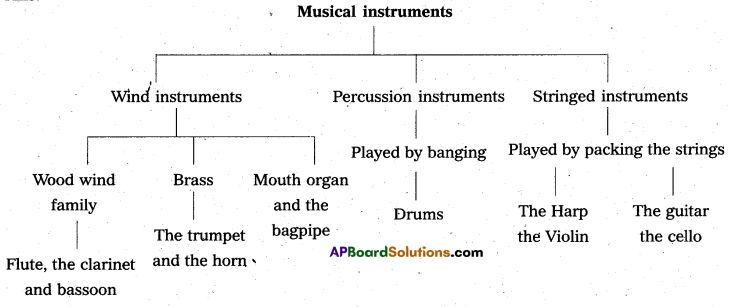
AP Inter 2nd Year English Grammar Note Making 1

Question 4.
Yoga is good for the mind and body. Regular practice of yoga helps people to improve their balance and stamina. Although you won’t really get out of breath, like you might playing football or running, it does help to keep your heart healthy and you can lose weight. It can also help with back pain.

The breathing taught in yoga can help people to reduce stress and anxiety. There are lots of different possible breathing patterns you can do. Yoga also improves concentration and helps people to sleep better, so it’s great for anyone who’s under pressure at work or in their studies.

There are lots of different types of yoga, so you can choose what suits you best. Hatha Yoga is often good for beginners, because you hold each position for a few breaths. In Vinyasa Yoga you change position much more quickly and you might get out of breath. It’s quite challenging if you haven’t done much yoga before. Bikram Yoga is sometimes called ‘hot yoga’, because the room must be heated to around 40 degrees. As well as these and other more traditional forms of yoga, there are also some more unusual modem forms of yoga. For example, you might enjoy ‘laughter yoga’, where people, do breathing exercises and laugh about nothing in particular – laughing is very good for your health. Or what about ‘Aeroyoga’, where you do yoga while you are hanging from the ceiling ? It’s supposed to be very good for your back. Or ‘Doga’, where you do yoga together with your pet dog?

Whatever kind of yoga you choose, there are definitely some health benefits, and you should have fun too.

Answer:

Yoga useful for mind and body – balance and stamina – playing football – heart healthy – breathing taught in yoga – reduces stress and anxiety – improves concentration.

Different types of yoga – Hatha yoga, Vinyasa yoga, Bikram yoga, modem ways – laughter yoga – good for health – yoga hanging over the ceiling, yoga with your pet dog – each of these have benefits and fun also.

Note Making Inter 2nd Year English Grammar

Question 5.
Is it possible for the colour of a uniform to affect the outcome of a sports match ? British anthropologists (scientists who study human behaviour) think so. In 2004, researchers studied the results of Olympic competitions in boxing, tae-know-do, and wrestling. These sports were great to study because uniform colours were randomly assigned. In each sport, contestants wearing red had a slight advantage. Those with red uniforms won a little more than half the time. Was this a matter of chance ? Or did red uniforms suggest danger and strength to opponents ? Many scientists have studied “the red effect.” Some have found that the colour of wrestler’s uniforms may affect a referee’s scoring. But nobody knows for sure. It’s not clear what effect red has on players, opponents, referees, and fans, or if it has any effect at all. It’s a great question to ask. And until it’s answered, you can be sure there will be many teams who are pinning their hopes on red.

Answer:

According to British Scientists – results of Olympics and Wrestling – contestants with red uniforms had a slight advantage.

Doubt is not cleared – the red effect – It may affect a referee’s scoring – players, opponents, referees and fans – the effect is not known – many teams opt for red uniforms.

Question 6.
Television is considered a vast media for communication. Television is at the same time considered a media running in everyone’s home carrying misinformation. Likewise, there are so many debates on the advantages and disadvantages of television. Strictly speaking, this is true. Television carries the news from one comer of the world to another at the same time it carries so many unwanted programs. The educational programs in television are innumerable. Lots of programs are available on Science and Technology. Current news is made available with audio and visuals through television. Many learning programs and social programs are also telecasted in many channels. This will be a great way to induce/motivate people to know and excel in their field of expertise. Women at home rely on television as their best companion. Women today at home cannot imagine a day without television. They can also find television as a medium to bring everyone in the family together for some time. Many animated programs and cartoon channels are telecasted for kids and children. Programs that are informative and teach them easily are also available in such channels. This also occupies the children when they are done with their assignments ! For people who work the whole day, Television is a big stress buster. Watching various channels, fun programs and songs would give them great relief.

Children start to become addicts to Television. This ultimately spoils their studies. Another great disadvantage is that watching Television for long hours might disturb a person’s sleep cycle, routine and severely affect one’s health too. The advertisements telecasted in TVs attract people to change their brands, increase their needs and wants; most important is children start pestering for stuff that are telecasted on Television. Though ; television played a vital role in carrying news and information across the world, after the advent of computers and internet, it has considerably lost its importance in the society.

Answer:

Television is a vast media of communication. So many debates – advantages and disadvantages – News from one comer to another. Many unwanted programs – programs on science and Technology. Women take T.V as their companion – Animated programmes and cartoon channels for children – watching T.V is a good habit. When it is under control children should not become addicts – computers and internet – a substitute for T.V.

Question 7.
The process of study involves four operations – perception, comprehension, retention and retrieval. In other words, you should first perceive what is relevant to your needs and select only those areas which are important. You cannot study everything available in every book you can lay your hands on. Once you have decided on areas, which are important, you have to read and understand – or comprehend the material that you have selected – for no learning can take place without comprehension. What is not Understood is not learnt. Comprehension is thus imperative in the process of learning. However, mere comprehension is not enough. What one understands now, may also be easily forgotten later. Hence, you, as a student, have to make special efforts to retain what you comprehend. You also have to retrieve all that you leam throughout the year at the time of examination.

Answer:

Four operations – perception, comprehension, retention and retrieval. Select the area of study – understand the material and comprehend. Sometimes forgetting is possible.
Try to retain the subject you studied.
You have to retrieve all that you learnt, at the time of examination.

Question 8.
There are four important types of heart diseases. Firstly, congenital heart disease, which is present at birth; an example of this is the so-called ‘blue baby’. It accounts for 2 percent of all heart diseases. The second type, rheumatic, is quite common in some 30 to 40 percent of all heart cases. It is caused by an infection of the throat which, is untreated causes damage to the heart. The symptoms are a chronic sore throat, painful joints and high fever. This disease is widespread in many developing countries, due to poor living conditions and overcrowding.

High blood pressure is also an important cause of heart disease, of the third type, hypertensive, and accounts for some 15 to 25 percept of all heart cases. It is believed that among other factors such as stress and smoking, a higher salt intake in the diet leads to blood pressure.

Degenerative heart disease, commonly known as Ischaemic heart disease, is the cause of heart attacks, and is one of the most important health problems among adults throughout the world. Ischaemic heart disease is due to blocking of the two blood vessels which supply blood to the heart muscle. At birth they are wide open, but in a diseased state one or more of these vessels is completely blocked, leading to defective blood supply to various points of the heart. This results in the well-known symptom of pain on emotional or physical stress called angina. What causes this is the laying down of a fatty substance, called cholesterol, in the wall of the artery, which gradually blocks the vessel and may close it completely.

How does cholesterol get into the blood ? It results partly from a diet rich in fats of animal origin, such as butter, cream, cheese, rich cuts of beef, ham and bacon, egg yolk, and saturated cooking fats, such as ghee.

Answer:

There are four types of heart diseases.
Congenital heart disease, rheumatic, hypertensive and degenerative heart disease.
First type – 2 percent, second type 30 to 40, Third 15 to 25 and the fourth type the remaining.
First type of heart disease – at birth also called ‘blue baby’.
Second type – Sore throat, painful joints.
Third type – High blood pressure.
Fourth type – because of blocked vessels.
Butter, cream, cheese, beef, ham and bacon etc., cause the increase in cholesterol.

Note Making Inter 2nd Year English Grammar

Question 9.
Like rivers, trees are our natural wealth. Trees prevent erosion or washing away of the soil. The thick roots or the trees absorb large quantity of water, hence reduce the danger of the flood by checking the flow of water. Trees provide a home for wild animals they produce many kinds of timber. To keep the air clean, trees are needed. We must grow more and more trees in and around our houses. “Grow more Trees” is a programme, patronized by the Indian govt. Under this programme, we plant new trees every year. This scheme has a great significance cutting down trees has resulted in the imbalance of environment. Trees are important not only to human beings but also to birds, and animals. Their branches give shelter to millions of birds, and the forests support the life of wild animals.

Answer:

Trees are natural wealth.
Floods are controlled.
They provide shelter for wild animals.
Timber is produced, Air is cleaned.
Govt arranges the programme “Grow more Trees”.
Even the birds and animals get shelter.
Wild life is saved by the trees.

Leave a Comment