
Attempting AP Inter 2nd Year Maths Study Material Chapter 10 Vector Algebra MCQ helps students become familiar with objective questions.
AP Inter 2nd Year Maths Vector Algebra MCQ
Question 1.
In triangle ABC (Fig), which of the following is not true:
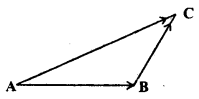
1) \(\overrightarrow{\mathrm{AB}}+\overrightarrow{\mathrm{BC}}+\overrightarrow{\mathrm{CA}}=\overrightarrow{0}\)
2) \(\overrightarrow{\mathrm{AB}}+\overrightarrow{\mathrm{BC}}-\overrightarrow{\mathrm{AC}}=\overrightarrow{0}\)
3) \(\overrightarrow{\mathbf{A B}}+\overrightarrow{\mathbf{B C}}+\overrightarrow{\mathbf{A C}}=\overrightarrow{\mathbf{0}}\)
4) \(\overrightarrow{\mathrm{AB}}-\overrightarrow{\mathrm{CB}}+\overrightarrow{\mathrm{CA}}=\overrightarrow{0}\)
Solution:
3) \(\overrightarrow{\mathbf{A B}}+\overrightarrow{\mathbf{B C}}+\overrightarrow{\mathbf{A C}}=\overrightarrow{\mathbf{0}}\)
Explanation:
\(\overrightarrow{\mathrm{AB}}+\overrightarrow{\mathrm{BC}}=\overrightarrow{\mathrm{AC}}\) [∵ Δle law]
\(\overrightarrow{\mathrm{AB}}+\overrightarrow{\mathrm{BC}}=\overrightarrow{\mathrm{AC}}\) = 0
⇒ \(\overrightarrow{\mathrm{AC}}+\overrightarrow{\mathrm{AC}}\) = 0
⇒ 2\(\overrightarrow{\mathrm{AC}}\) = 0
∴ A, B andC are on the same line not form triangle.
Hence option (3) is correct.

Question 2.
If \(\vec{a} \text { and } \vec{b}\) are two collinear vectors, then which of the following is correct
1) \(\overrightarrow{\mathbf{b}}=\lambda \overrightarrow{\mathbf{a}}\) for some scalar λ ≠ 0.
2) \(\vec{a}= \pm \vec{b}\)
3) the respective components of \(\vec{a} \text { and } \vec{b}\) are not proportional
4) both the vectors \(\vec{a} \text { and } \vec{b}\) have same direction, but different magnitudes.
Solution:
1) \(\overrightarrow{\mathbf{b}}=\lambda \overrightarrow{\mathbf{a}}\) for some scalar λ ≠ 0.
Question 3.
If \(\overrightarrow{\mathbf{a}}\) is a nonzero vector of magnitude ‘a’ and λ. a nonzero scalar, then \(\lambda \overrightarrow{\mathbf{a}}\) is unit vector if
1) λ = 1
2) λ = – 1
3) a = |λ|
4) a = 1/| λ|
Solution:
4) a = 1/| λ|
Explanation:
λā is a unit vector ⇒ |λā| = 1
⇒ |λ| |ā| = 1
a = \(\frac{1}{|\lambda|}\)
Hence, option (4) is correct.
Question 4.
Let the vectors \(\vec{a} \text { and } \vec{b}\) be such that \(|\overrightarrow{\mathrm{a}}|=3,|\overrightarrow{\mathrm{~b}}|=\frac{\sqrt{2}}{3}\), then \(\overrightarrow{\mathbf{a}} \times \overrightarrow{\mathbf{b}}\) is a unit vector, if the angle between \(\vec{a} \text { and } \vec{b}\) is
1) π/6
2) π/4
3) π/3
4) π/2
Solution:
2) π/4
Explanation:
Given ā = 3 and |b̄| = \(\frac{\sqrt{2}}{3}\), |ā × b̄| = 1
|ā||b̄| sin θ = | ā × b̄ | ⇒ 3 × \(\frac{\sqrt{2}}{3}\) sin θ = 1
⇒ sin θ = \(\frac{1}{\sqrt{2}}\)
sin θ = sin \(\frac{\pi}{4}\)
θ = \(\frac{\pi}{4}\)
Hence, option (2) is correct.
Question 5.
Area of a rectangle having vertices A, B, C and D with position vectors \(-\hat{\mathbf{i}}+\frac{1}{2} \hat{\mathbf{j}}+4 \hat{\mathbf{k}}, \hat{\mathbf{i}}+\frac{1}{2} \hat{\mathbf{j}}+4 \hat{\mathbf{k}}, \hat{\mathbf{i}}-\frac{1}{2} \hat{\mathbf{j}}+4 \hat{\mathbf{k}} \text { and }-\hat{\mathbf{i}}-\frac{1}{2} \hat{\mathbf{j}}+4 \hat{\mathbf{k}}\), respectively is
1) 1/2
2) 1
3) 2
4) 4
Solution:
3) 2
Explanation:
\(\frac{1}{2}\) = 2î & \(\frac{1}{2}\) = -ĵ
\(\frac{1}{2}\) = 2î × (-ĵ) = -2(î × ĵ) = -2k̂
∴ Area = \(\frac{1}{2}\) = √4 = 2
Hence, option (3) is correct
Question 6.
If θ is the angle between two vectors \(\vec{a} \text { and } \vec{b}\), then \(\vec{a} \text.\vec{b}\) > 0 only when
1) 0 < θ < \(\frac{\pi}{2}\)
2) 0 ≤ θ ≤ \(\frac{\pi}{2}\)
3) 0 < θ < π
4) 0 ≤ θ ≤ π
Solution:
2) 0 ≤ θ ≤ \(\frac{\pi}{2}\)
Explanation:
If θ is the angle between ā and b̄ then the angle
between vectors a and b ā. b̄ = |ā||b̄| cos θ.
The dot product to be non-negative
⇒ (a – b) ≥ 0 ⇒ cos 0 ≥ 0
∴ Range 0 ≤ θ ≤ \(\frac{\pi}{2}\)
Hence option (2) is correct.
Question 7.
Let \(\vec{a} \text { and } \vec{b}\) be two unit vectors and θ is the angle between them. Then \(\overrightarrow{\mathbf{a}}+\overrightarrow{\mathbf{b}}\) is a unit vector if
1) θ = \(\frac{\pi}{4}\)
2) θ = \(\frac{\pi}{3}\)
3) θ = \(\frac{\pi}{2}\)
4) θ = \(\frac{2\pi}{3}\)
Solution:
4) θ = \(\frac{2\pi}{3}\)
Explanation:
Given |ā| = 1, |b̄| = 1 & |ā + b̄| = 1
Squaring on both sides |ā| + |b̄| + 2|ā||b̄| cos θ = 1
1 + 1 + 2 cos θ = 1
cos θ = – \(\frac{1}{2}\)
⇒ cos θ = cos \(\frac{2 \pi}{3}\)
θ = \(\frac{2 \pi}{3}\)
Hence option (4) is correct.
Question 8.
The value of \(\hat{\mathbf{i}} \cdot(\hat{\mathbf{j}} \times \hat{\mathbf{k}})+\hat{\mathbf{j}} \cdot(\hat{\mathbf{i}} \times \hat{\mathbf{k}})+\hat{\mathbf{k}} \cdot(\hat{\mathbf{i}} \times \hat{\mathbf{j}})\) is
1) 0
2) -1
3) 1
4) 3
Solution:
3) 1
Explanation:
ī.(j̄ × k̄) + j̄.(ī × k̄) + k̄.(ī × j̄)
= ī.ī – j̄.j̄ + k̄.k̄
= 1 – 1 + 1 = 1
Hence option (3) is correct
Question 9.
If θ is the angle between any two vectors \(\vec{a} \text { and } \vec{b}\), then \(|\overrightarrow{\mathrm{a}} \cdot \overrightarrow{\mathrm{~b}}|=|\overrightarrow{\mathrm{a}} \times \overrightarrow{\mathrm{b}}|\) when θ is equal to 10.
1) 0
2) \(\frac{\pi}{4}\)
3) \(\frac{\pi}{2}\)
4) π
Solution:
2) \(\frac{\pi}{4}\)
|ā . b̄| = |ā × b̄|
|ā| |b̄| cos θ = |ā| |b̄| sin θ
⇒ cos θ = sin θ
⇒ θ = \(\frac{\pi}{4}\)
Hence option (2) is correct
Question 10.
The value of the dot product of \(\vec{a}-\vec{b} \text { and } \vec{a}+\vec{b}/latex] is
1) a2 – b2
2) [latex](\vec{a} \times \vec{b})\)
3) \(\overrightarrow{\mathbf{a}} \times \overrightarrow{\mathbf{b}}\)
4) \(\overrightarrow{\mathbf{b}} \times \overrightarrow{\mathbf{a}}\)
Solution:
1) a2 – b2
Explanation:
|ā – b̄| |ā + b̄| = ā.ā + ā.b̄ – b̄.ā – b̄.b̄
= |ā|2 – |b̄|2
= a2 – b2
Hence option (1) is correct
Question 11.
The position vector of the point (1, 2, 0)is
1) \(\overrightarrow{\mathrm{i}}+\overrightarrow{\mathrm{j}}+\overrightarrow{\mathrm{k}}\)
2) \(\overrightarrow{\mathrm{i}}+\overrightarrow{\mathrm{2j}}+\overrightarrow{\mathrm{k}}\)
3) \(\vec{i}+2 \vec{j}\)
4) \(2 \vec{j}+\vec{k}\)
Solution:
3) \(\vec{i}+2 \vec{j}\)
Explanation:
Position vector = ī + 2j̄
Hence option (3) is correct.
Question 12.
If \(|(\vec{a} \times \vec{b})|=4 \text { and }|\vec{a} \cdot \vec{b}|=2\) then \(\left.\overrightarrow{\mathbf{a}}\right|^2|\overrightarrow{\mathbf{b}}|^2\) is equal to
1) 4
2) 2
3) 20
4) 2
Solution:
3) 20
Explanation:
|ā × b̄| = 4 and |ā . b̄| = 2
|ā × b̄|2 + |ā.b̄|2 = |ā|2
42 + 22 = |āl|2 |b̄|2
|ā|2 |b̄|2 = 20
Hence option (3) is correct
Question 13.
The points with position vectors \(10 \bar{i}+3 \bar{j}, 12 i-5 \vec{j} \text { and } a \dot{i}+11 j\) are collinear, if a is
1) 2
2) -8
3) 4
4) 8
Solution:
4) 8
Explanation:
\(\frac{1}{2}\) = 10ī + 3j̄, OB = 12ī – 5j̄ & OC = aī + 11j̄
\(\overrightarrow{\mathrm{AB}}=\overrightarrow{\mathrm{OB}}-\overrightarrow{\mathrm{OA}}\) = 2ī – 8j̄
\(\overrightarrow{\mathrm{BC}}=\overrightarrow{\mathrm{OC}}-\overrightarrow{\mathrm{OB}}\) = (a -12)ī + 16j̄
Given points are collinear, then
\(\frac{a-12}{2}=\frac{16}{-8}\)
⇒ a – 12 = -4
⇒ a = 8
Hence option (4) is correct.
Question 14.
The vector cos α cosβ \(\vec{i}\) + cosα sinβ \(\vec{j}\) + sinα \(\vec{k}\) is
1) null vector
2) unit vector
3) constant vector
4) vector with magnitude > 1
Solution:
2) unit vector
Explanation:
ā = cos a cos (5 i + cos a sin P j + sin a k
|ā| = \(\sqrt{\cos ^2 \alpha \cos ^2 \beta+\cos ^2 \alpha \sin ^2 \beta+\sin ^2 \alpha}\)
= \(\sqrt{\cos ^2 \alpha\left(\cos ^2 \beta+\sin ^2 \beta\right)+\sin ^2 \alpha}\)
= \(\sqrt{\cos ^2 \alpha+\sin ^2 \alpha}\) ⇒ |ā| = 1
∴ ā is a unit vector.
Hence option (2) is correct
Question 15.
If \(\vec{a}\), \(\vec{b}\), \(\vec{b}\) are mutually perpendicular unit vectors, then the value of |\(\vec{a}\) + \(\vec{b}\) + \(\vec{c}\)| is
1) 1
2) \(\sqrt{2}\)
3) \(\sqrt{3}\)
4) 2
Solution:
3) \(\sqrt{3}\)
Explanation:
|ā| = |b̄| = |c̄| = 0, ā.b̄ = 0, b̄.c̄ = 0 and c̄.ā = 0
|ā + b̄ + c̄|2
= |ā|2 + |b̄|2 + |c̄|2 + 2(ā.b̄ + b̄.c̄ + c̄.ā) = 0 = 1 + 1 + 1 = 0
∴ |ā + b̄ + c̄| = √3
Hence option (3) is correct.
Question 16.
If \(\vec{a}\) + \(\vec{b}\) + \(\vec{c}\), |\(\vec{a}\)| = 3, |\(\vec{b}\)| = 5, |\(\vec{c}\)| = 7 then the angle between \(\vec{a} \text { and } \vec{b}\) is
1) \(\frac{\pi}{6}\)
2) \(\frac{2\pi}{3}\)
3) \(\frac{5\pi}{3}\)
4) \(\frac{\pi}{3}\)
Solution:
4) \(\frac{\pi}{3}\)
Explanation:
ā + b̄ + c̄ = 0 ⇒ ā + b̄ = -c̄
Squaring on both sides |ā|2 + |b̄|2 + 2|ā| + |b̄|cos 0 = |c̄|2
⇒ 9 + 25 + 30 cos 0 = 49
⇒ 30 cos θ = 15
⇒ cos θ = \(\frac{1}{2}\)– ⇒ cos θ = cos \(\frac{\pi}{3}\) ⇒ θ = \(\frac{\pi}{3}\)
Hence option (4) is correct
Question 17.
If \(\vec{a} \text { and } \vec{b}\) are two unit vectors inclined atan angle θ then the Value of |\(\vec{a}\) – \(\vec{b}\)| is
1) 2sin\(\frac{\theta}{2}\)
2) 2sinθ
3) 2cos\(\frac{\theta}{2}\)
4) 2cosθ
Solution:
1) 2sin\(\frac{\theta}{2}\)
Explanation:
|ā – b̄|2 = |ā|2 +|b̄|2 – 2|ā||b̄| cos θ
= 1 + 1 – 2 cos θ
= 2 – 2 cos θ = 2(1 – cos θ)
|ā – b̄|2 = 4 sin2\(\frac{\theta}{2}\)
|ā – b̄| = 2 sin\(\frac{\theta}{2}\)
Hence option (1) is correct
Question 18.
If |\(\vec{a}\)|= 3 and -1 ≤ k ≤ 2 then | k\(\vec{a}\) |lies in the internal
1) [0, 6]
2) [-3, 6]
3) [3, 6]
4) [1, 2]
Solution:
1) [0, 6]
Explanation:
|kā| = |k|.|ā| ⇒ |k|.3
The minimum value is 0.(3) = 0
The maximum value is 2(3) = 6
∴ The range of |k ā| is [0, 6]
Hence option (1) is correct.